Flame Retardancy on a Solar Cable Datasheet
Fire behaviour shows up on a KUKA CABLE datasheet in two places: the material line, where the sheath and insulation are listed as XLPO, electron-beam cross-linked and LSHF, and the test line, where the published PV check burns a single cable vertically at 800 °C for one minute and expects it to stop burning by itself. A CPR fire rating is named as a regional requirement. Everything else about fire performance has to be requested as a report.
Key takeaways
- The sheath and insulation are both published as XLPO, electron-beam cross-linked and LSHF.
- The published flame check exposes a single cable to vertical burning at 800 °C for one minute and expects self-extinguishing behaviour.
- CPR fire rating and AD8 waterproofing are named as regional requirements rather than universal ones.
- Conductor data sits on the same sheet: the 4 mm² build uses 56 strands of 0.29 mm, and every step up in size adds more.
The material line a specifier should read first
On the 1500 V construction the insulation and the sheath are the same family of material: XLPO, electron-beam cross-linked and LSHF. Cross-linking turns the polymer into a three-dimensional network, which is what stops it flowing when a conductor gets hot. LSHF stands for low smoke, halogen free, and it describes what the material does when a fire does reach it: less smoke and no halogen acids in the plume.
Those two properties answer different questions, and datasheets often blur them. Thermal stability decides how the cable behaves in normal service at +90 °C ambient or during a +250 °C short-circuit event lasting 5 s. Halogen content decides what a burning cable does to a room, a stairwell or an inverter enclosure. A specifier who needs the second should not accept a sentence about the first, and should ask for the solar cable sheet to state the halogen-free rating in writing rather than leaving it to be inferred.
What the published flame test involves
KUKA CABLE describes a vertical flame test for PV cables in which a single cable is exposed to burning at 800 °C for one minute, after which it should extinguish itself. Note the details: one cable, not a tray of cables; vertical, which is the arrangement that lets flame climb; one minute of exposure; and a stated outcome rather than a pass mark in a class system.
The test answers a narrow question well. It shows that a sample, once the ignition source is removed, does not keep feeding a fire along its own length. It does not describe smoke density, toxicity, heat release or how a bundle behaves in a tray, and the site publishes no figures for those. If a project needs them, they belong in a separate request with the target standard named.
Regional ratings, read as regional
Two ratings are highlighted by the company as requirements that vary by market: a CPR fire rating and an AD8 waterproofing rating. CPR belongs to construction products regulation in Europe, and AD8 describes a water-tightness level that matters in wet or buried routes. Both are relevant to fire or water performance, and neither replaces the material line on the datasheet.
The wider certificate list is worth knowing when a market has its own rulebook: more than 30 types of certificates are listed, including TUV, IEC, CE, SAA and UL, with UL described as being updated. A cable that satisfies an EN-based construction will not automatically satisfy a North American one, which is the practical reason the same factory publishes both routes. The same construction is qualified against TUV 2PfG 1169/08.2007, EN 50618:2014 and IEC 62930, so the flame line and the standards line describe one build rather than two.
The construction numbers printed alongside
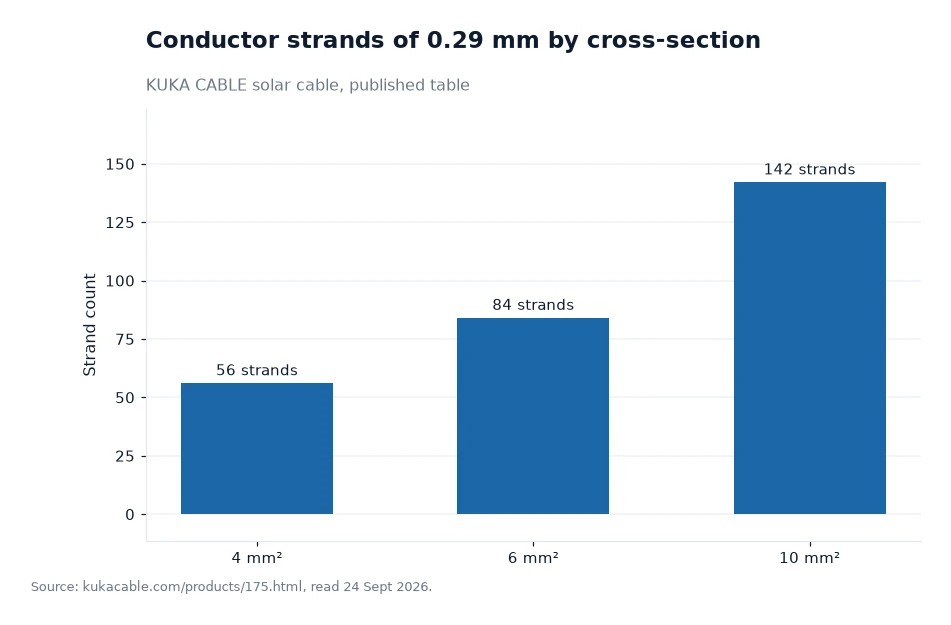
Fire lines on a datasheet usually sit a few rows away from construction data, and the two are worth reading together. The published cross-section table gives 4 mm² as 56 strands of 0.29 mm at 5.5 mm overall diameter and 59 g/m, 6 mm² as 84 strands of 0.29 mm at 6.0 mm and 78 g/m, and 10 mm² as 142 strands of 0.29 mm at 7.5 mm and 130 g/m. Insulation wall is 0.7 mm and sheath wall 0.8 mm across that range.
Wall thickness is the part that matters here. A thinner sheath reaches its failure temperature sooner, and a thinner wall is also easier to damage during installation, which is where most moisture ingress begins. The site publishes an AD8 waterproofing rating and a bending radius of 4 × the outer diameter, so a 6.0 mm cable should not be forced into a bend tighter than 24 mm — that multiplication is mine, done on the published diameter.
Where a buyer should look next
The site keeps a dedicated content section on cable construction, characteristics and the risks of cutting corners, and it is the natural next read after a datasheet. For a flame question specifically, three items are worth requesting: the report for the vertical flame test on the construction being ordered, confirmation of the halogen-free rating in writing, and any market-specific rating such as CPR if the project is sited where it applies. The visible construction notes explain the design intent; the reports are what a project can file.
| Datasheet line | Published value | What it answers |
|---|---|---|
| Insulation material | XLPO, electron-beam cross-linked, LSHF | heat stability and low smoke behaviour |
| Sheath material | XLPO, electron-beam cross-linked, LSHF | outer protection under fire and moisture |
| Flame behaviour | 800 °C vertical burn, one minute | whether a burning sample feeds its own flame |
| Regional rating | CPR fire rating | market-specific construction requirement |
| Water rating | AD8 waterproofing | resistance to wet routes and ponding |
| Temperature limits | +90 °C ambient, +250 °C for 5 s | the thermal envelope the material was qualified in |
Worked example
The chart in this section comes from the manufacturer's cross-section table and counts strands rather than flame behaviour, which is the honest limit of the figure. Its title is "Conductor strands of 0.29 mm by cross-section", and the bars read 56 strands at 4 mm², 84 at 6 mm² and 142 at 10 mm², from kukacable.com/products/175.html. Working from strand geometry, one strand of 0.29 mm has an area of about 0.066 mm² using π/4 × d², so 84 strands come to roughly 5.55 mm² of copper and 56 strands to about 3.70 mm². Those numbers are mine, they ignore lay and compaction, and they are the reason the nominal size on a datasheet is a rounded standard value rather than a sum of strand areas.
Frequently asked questions
Does an LSHF rating make a cable fireproof?
No. LSHF describes low smoke and halogen-free behaviour when the material does burn, not immunity to fire. The published flame check is a vertical burn at 800 °C for one minute on a single cable, after which the sample is expected to self-extinguish. A project that needs a rated construction for a building should ask for the market-specific rating such as CPR alongside the material line.
Why does the datasheet not give a flame class?
The site publishes the test description and names CPR as a regional requirement, but it does not list a flame spread class for every construction, and no smoke density figures appear. That is a gap a buyer can close by asking for the flame test report and the certificate for the exact size on order, rather than by reading a class number that may not apply to that construction.
What to write into the order
Name the material requirements in the same row as the electrical ones: cross-linked XLPO insulation and sheath, LSHF behaviour, and the market rating that applies where the cable will be installed. Ask for the vertical flame report and the certificate covering the size being bought, and check the wall thickness against the published 0.7 mm and 0.8 mm. If the site is coastal, wet or buried, bring the AD8 waterproofing rating into the same conversation — fire and water questions often arrive at the same joint.
Flame-retardancy wording comes from the manufacturer's own website, kukacable.com, annotated 24 Sept 2026[1].