From Ranking Page to Chat: A Ten-Minute Workflow
Choosing well does not require browsing for an hour. It requires a sequence: scan the board for counters, narrow by tag, read two descriptions, then commit to one thread. Done in that order the whole path takes about ten minutes, and repeated once a week it produces roughly 40 minutes of decision-making a month against hours of aimless scrolling. If you only take one number from this article, take that one.

Key takeaways
- Spend the first two minutes on counters only. Views tell you reach; favourites tell you fit; the ratio between them tells you which cards deserve a description read.
- The board holds 20 NSFW AI characters and refreshes every Thursday, so a weekly pass is enough to catch every change that matters.
- Read two descriptions, not ten. The third reads faster once you have narrowed the register, and the tenth adds nothing.
- Illustratively, six weeks of weekly passes produce 34 sessions from additions of 3, 4, 5, 6, 7 and 9.
The ten minutes, broken down
Minutes zero to two belong to the board. Do not read anything yet: scan the counters and pick out three cards whose focus is a workable ratio rather than the largest view count. A card with 24.3M views and 7.1K favourites, for instance, converts at about 0.029%, which is a better guide to whether people stay than the raw volume.
Minutes two to five belong to tags. Match the three candidates against the labels you would actually search — Unfiltered, Submissive, Fictional, OC and Female are the kinds of tags the cards carry — and drop any card whose label set means you would never have found it on your own. That single filter usually removes one of the three.
Minutes five to eight belong to descriptions. Read the remaining two fully. The question to answer is not whether the premise is interesting but whether the promised register is one you would sustain for twenty minutes. If both pass, pick the one whose description is more specific; if only one passes, the workflow has already paid for itself.
Minutes eight to ten belong to the first exchange. Send three messages that establish context, set the register and hand over a direction. Three is deliberate: enough to test the reply behaviour, few enough that abandoning the thread costs nothing.
If a step overruns, cut it rather than the sequence. Ten minutes is a budget, not a rule: dropping the description read is better than skipping the tag match, and skipping the tag match is better than opening a third card. The value comes from the order, and that order survives compression at every step.
Why the order matters
Each step is cheaper than the one after it, and the sequence exploits that. Scanning counters costs seconds. Applying tags takes a click. Reading a description takes a minute. Starting a conversation costs a session. Running the tests in reverse — chatting first and checking the numbers afterwards — is how a ten-minute decision becomes a two-hour one.
The weekly cadence follows from the board itself. Because the rankings are re-cut every Thursday, a Friday pass captures the new slate with a full week ahead of it. There is no benefit to checking daily, since nothing in the ordering changes until the next reset.
There is also a shortened version for returning readers. Skip the counters, because you already know which three or four cards you would consider, and spend the full ten minutes on tags and descriptions alone. Fewer candidates get examined more cheaply, and the session at the end still costs exactly one visit.
Anyone who dislikes structure can keep a useful half-measure: fix only the first step. Two minutes on counters, then whatever happens next. That single constraint usually removes half the browsing time, because the shortlist has already been narrowed before the pleasant part begins.
| Minutes | Step | What it tests |
|---|---|---|
| 0–2 | Scan counters on the board | Whether people who opened a card kept it |
| 2–5 | Match candidate tags to your own search habits | Whether you would have found the card yourself |
| 5–8 | Read two descriptions in full | Whether the promised register is sustainable |
| 8–10 | Send three opening messages | Whether the replies match the description |
| Day seven | Return to the same thread once | Whether context carried across the gap |
Worked example
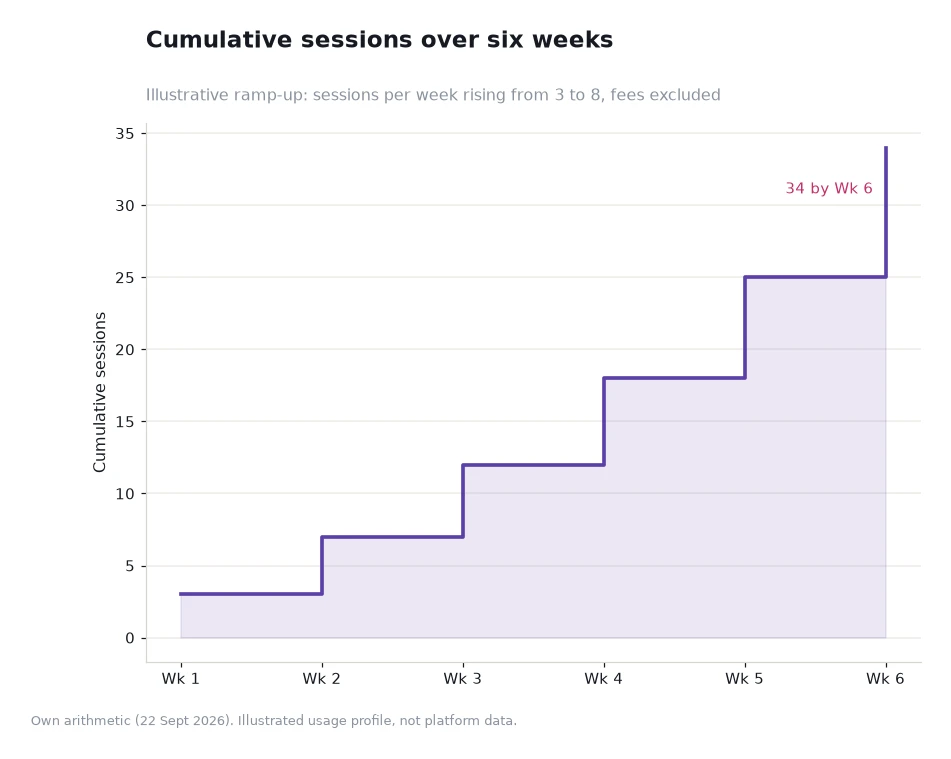
Attach a schedule to the workflow and the arithmetic is straightforward. The illustration below models weekly use only, and it is an assumption set rather than platform data. Weekly additions of 3, 4, 5, 6, 7 and 9 sessions give cumulative totals of 3, 7, 12, 18, 25 and 34.
Follow the line: week one ends at 3. Week two adds 4 for 7. Week three adds 5 for 12. Week four adds 6 for 18. Week five adds 7 for 25. Week six adds 9 for 34. The chart's subtitle describes a ramp-up from about 3 sessions a week towards 8, and the final week's 9 is what carries the total to 34.
Now compare that with the cost of the workflow itself. A ten-minute pass each Friday is 40 minutes a month and about ten minutes per session once the schedule settles. The decision cost stays flat while the sessions accumulate, which is the property that makes a workflow worth having at all.
Where to run the workflow
Start from https://crushon.ai/trends/nsfw_ai, which carries both counters on every card, then keep the weekly rankings open in a second tab for the Creators and Characters lists. If the tag step is the hard part, the character search view is where the popular labels are easiest to browse.
Two refinements are worth adding after the first month. Note which cards survive a Thursday reset twice, because that filters out novelty traffic without any further reading. Then keep the three opening messages in a note so the tenth workflow starts faster than the first — the fastest workflow is one that has already decided what it is looking for.
Frequently asked questions
Does the workflow need ten minutes every week?
Ten minutes on the first pass and about five afterwards, because the tag step becomes quick once you know your own shortlist.
Should I read more than two descriptions?
No. The first two carry almost all the information; beyond that you are optimising a decision that costs one session to test directly.
What if nothing on the board fits?
Skip the week. The slate is re-cut every Thursday, so the cost of waiting is seven days and the cost of settling is a session you will not finish.
Make the decision cheap, then make it often
Counters, tags, two descriptions, three messages: that is the whole method. Run it on a Friday and you have captured the new slate before the week starts. Ten minutes once a week is a fraction of the time an unstructured browse takes, and the difference lies entirely in the order of the steps.
Keep a line of notes per week and the shortlist improves on its own, because the pattern of what you return to becomes visible after four or five passes. After two months the shortlist is the record, and it is more useful than any note you write about it. This piece is written for adults of 18 and over.
Data and sources: trend card counters, the 20-card slate and the weekly Thursday refresh, read from the Crushon trends pages on 22 Sept 2026[1]. Ratios are arithmetic on published counters; the six-week session schedule and the 40-minute monthly decision cost are illustrative assumptions. Adults 18+.