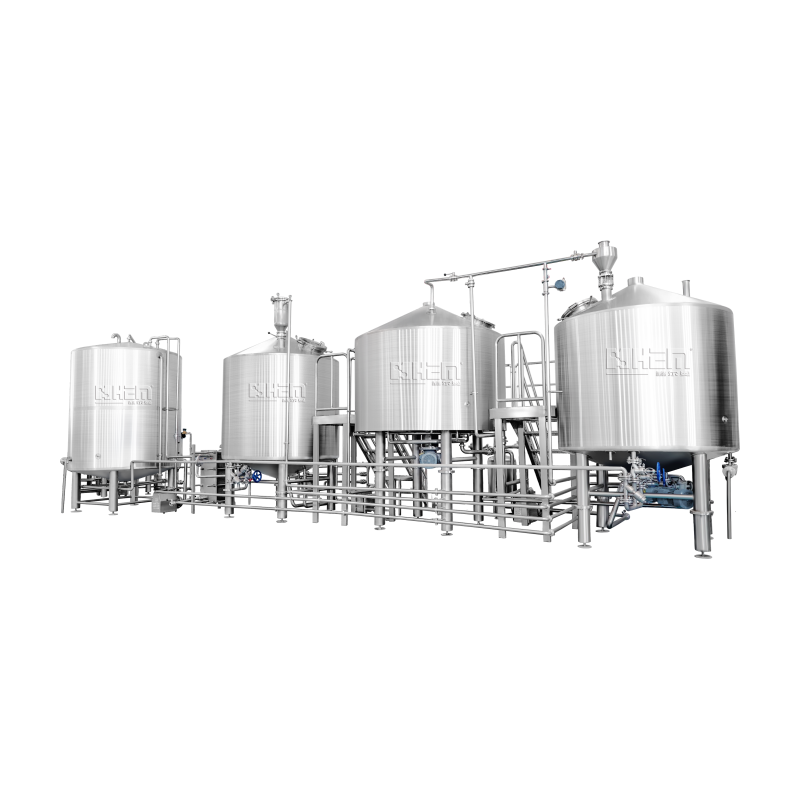
Brewing equipment improves production efficiency by shortening batch cycles, raising extract recovery, reducing water and energy use, and keeping fermentation conditions repeatable. A brewhouse that cuts a 240-minute cycle to 210 minutes gains 12.5% more available production time per batch. Raising brewhouse efficiency from 80% to 85% produces about 6.25% more recovered extract from the same malt input. The Brewers Association has reported brewery water-use medians ranging from about 4.5 to 13.1 barrels of water per barrel of beer depending on annual production scale. Equipment selection therefore affects output, utility cost, labor hours, product loss, cleaning time, and tank utilization.
Production efficiency starts with cycle time rather than vessel volume. A 20 hL brewhouse completing one batch every 4 hours can theoretically complete three batches during a 12-hour production window. Cutting the cycle to 3.5 hours does not enlarge the vessels, but it reduces time per batch by 12.5% and can create enough room for another production stage before the shift ends.
The time difference normally comes from several smaller changes rather than one fast machine. Faster strike-water preparation, stable mash heating, controlled wort transfer, improved lautering and correctly sized heat exchangers can remove 5–15 minutes from individual stages. When four process stages each lose 10 minutes, the batch cycle becomes 40 minutes shorter.
Equipment capacity should therefore be compared with actual cycle time. A 30 hL brewhouse requiring 300 minutes per batch may produce less wort during a long production day than a 25 hL system running a well-balanced 210-minute cycle.
Once cycle time is under control, malt recovery becomes the next measurable area. Brewhouse efficiency describes how much of the potential extract in malt reaches the wort. If one process recovers 80 units from a fixed malt charge and another recovers 85, the second system obtains 6.25% more usable extract from the same quantity of grain.
Mill configuration affects that number before the mash begins. Roll gap that is too wide can leave endosperm insufficiently crushed, while excessive crushing can damage husks and reduce filter-bed permeability. Modern two-, four-, or six-roll mills give operators more control over particle distribution, especially where breweries process several malt types with different kernel sizes.
Mash equipment then has to distribute water evenly through the grist. Poor mixing can leave dry material inside a mash containing hundreds of kilograms of malt. Variable-speed agitators, accurate water metering and multiple temperature sensors help keep mash conditions more uniform instead of relying on a single temperature reading from one point in a vessel.
A temperature error of only 2–3°C can change enzyme activity during a conversion rest. Automated steam or hot-water control is useful because the system can reduce heat input as the target temperature approaches, rather than allowing the mash to overshoot and then requiring cooling or dilution.
The same attention moves into lautering. Wort separation can occupy 60–120 minutes in many brewhouse schedules, so small changes matter. Rake height, rake speed, differential pressure, wort clarity, bed depth and sparge-water distribution all affect how quickly wort can pass through the grain bed without compacting it.
High flow is not automatically productive. If the grain bed compresses, runoff can slow enough to erase the minutes gained earlier. A controlled pump or variable-frequency drive can maintain a more stable flow, while differential-pressure readings show operators when resistance through the bed is increasing.
That relationship is one reason experienced Beer Brewing Equipment Manufacturers normally size the mash vessel, lauter tun, wort pumps and piping as one process rather than treating every component as a separate purchase. A pump capable of 200 L/min offers little benefit when the downstream heat exchanger or pipe diameter safely handles only 100 L/min.
Boiling creates another measurable energy requirement. Raising 2,000 kg of water-equivalent liquid by 60°C requires roughly 502 MJ, or about 139.5 kWh of theoretical heat, before vessel, steam, condensate and ambient losses are included. A 40 hL batch roughly doubles the liquid mass, so thermal efficiency becomes more important as production volume rises.
Vessel insulation reduces heat escaping through stainless-steel surfaces during mashing and boiling. Steam jackets also need sufficient surface area and pressure control; adding excessive steam pressure does not automatically shorten heating time if heat-transfer area has become the limiting condition.
| Production area | Example measurable change | Operational effect |
|---|---|---|
| Brewhouse cycle | 240 to 210 min | 12.5% less time per batch |
| Extract recovery | 80% to 85% | 6.25% more recovered extract |
| Transfer loss | 4% to 2% | 2 extra hL retained per 100 hL |
| CIP time | 90 to 70 min | 22.2% shorter cleaning window |
| Packaging yield | 94% to 97% | 3 hL more packaged per 100 hL sent |
Cooling offers an opportunity to recover part of the heat already purchased. Wort leaving the kettle can be above 95°C and may need to reach roughly 8–20°C before yeast pitching, depending on beer style and fermentation process. A properly sized plate heat exchanger transfers much of that thermal energy into cold brewing water instead of sending it into a drain or refrigeration system.
Recovered hot water can then enter a hot-liquor tank for the following mash, sparge or cleaning cycle. If 2,000 L of water leaves a heat exchanger at 70°C rather than entering the next heating stage at 15°C, the brewery avoids reheating that volume through a 55°C temperature rise.
That saved temperature rise represents about 460 MJ, or 128 kWh of theoretical thermal energy for 2,000 kg of water. Real operating savings depend on heat losses and system efficiency, but the calculation shows why hot-water storage capacity should be matched to brewhouse scheduling rather than selected only by tank diameter.
Water use deserves the same measurement. The Brewers Association reported in its 2015 benchmarking work that median water use varied by brewery size: about 13.1 barrels of water per barrel of beer among breweries producing 1,000–10,000 barrels annually, 5.9 for the 10,000–100,000-barrel group and 4.5 for breweries above 100,000 barrels.
The association has also noted that average brewery water use has been around 7 barrels of water per barrel of beer, while some craft breweries have operated below 3:1. Facilities without well-developed water conservation practices may exceed 10 gallons of water for each gallon of beer produced.
Equipment design affects much of that difference because brewing water is only one part of total consumption. Tank rinsing, floor cleaning, keg washing, bottle or can processing, cooling, hose use and CIP can consume substantial volumes that never enter packaged beer.
A CIP skid can reduce variation by controlling detergent concentration, return temperature, circulation time and flow instead of cleaning every vessel manually. If a 90-minute manual cycle is replaced by a repeatable 70-minute sequence, cleaning time falls 22.2%. Across six tanks, that removes two hours from the combined cleaning schedule.
Flow also matters during CIP. Too little velocity may leave residues on pipe surfaces, while excessive pump capacity wastes electricity and can create unnecessary mechanical stress. Conductivity sensors can help distinguish chemical solution from rinse water, allowing the controller to stop rinsing when the measured condition reaches the specified range instead of relying only on a fixed timer.
Reusing cleaning solution also changes resource use. A properly designed recovery system can return suitable caustic or rinse water to a holding tank rather than sending the entire volume to wastewater after one cycle.
Reduced cleaning time becomes useful only when fermentation capacity can accept the extra wort. A brewhouse producing 100 hL per day cannot sustain that output if only 300 hL of fermentation space is available for beers occupying tanks for 14–21 days.
For example, ten 100 hL fermenters provide 1,000 hL of nominal fermentation volume. If an average beer occupies a vessel for 14 days plus one day for emptying and cleaning, theoretical turnover is about 24 tank cycles per year before maintenance and scheduling losses. Extending occupancy from 15 to 18 days reduces theoretical annual turns by roughly 16.7%.
Accurate glycol control helps keep those schedules repeatable. Individual cooling zones, proportional valves and digital temperature probes can control each tank separately rather than circulating maximum cooling whenever a thermostat calls for refrigeration. A fermentation temperature difference of 1–2°C can alter fermentation speed and yeast behavior, so temperature stability affects scheduling as well as beer consistency.
Tank pressure, liquid level and fermentation temperature can also be logged automatically. Instead of an operator checking 20 vessels one by one, one control interface can display process status and alarm conditions. Labor saved from routine observation can be moved to yeast management, cellar work, quality checks or packaging.
Automation has a similar role in the brewhouse. Flow meters can stop water addition at a preset volume, load cells can verify vessel contents, automated valves can select transfer paths, and variable-frequency drives can alter pump or agitator speed. Removing five manual interventions from each of six daily batches removes 30 repeated operator tasks from the schedule.
Production records become more useful when measurements use the same format every batch. A brewery can compare mash-in time, first-wort gravity, kettle-full volume, evaporation rate, original gravity, cooling time, fermentation duration, packaged volume and CIP time. Differences of 3%, 5% or 10% become visible before they become accepted as ordinary plant behavior.
Packaging losses should be included because brewhouse volume is not the same as saleable volume. Sending 100 hL of finished beer to packaging at a 94% yield produces 94 hL of packaged beer. Raising packaging yield to 97% provides 3 additional hL without brewing another batch.
Similar losses occur in hoses, tank bottoms, transfer lines and poorly drained pipework. Reducing total process loss from 4% to 2% retains 2 hL from every 100 hL produced. Across 10,000 hL of annual throughput, the difference reaches 200 hL of beer.
Equipment layout can reduce part of that loss while also shortening labor time. Shorter sanitary pipe runs contain less residual beer, pumps can be positioned closer to vessels, and sloped piping improves drainage. A 50 mm internal-diameter pipe 30 meters long holds roughly 59 liters; reducing an unnecessary run by 15 meters cuts its internal volume by about 29 liters.
Utility equipment must finally match the production equipment. A larger brewhouse can underperform when steam generation, glycol refrigeration, electrical supply, compressed air or hot-water storage was sized for an earlier plant. Increasing brewhouse volume by 50% while leaving cooling capacity unchanged can simply move the waiting time from the kettle to the heat exchanger or fermentation cellar.
Efficiency therefore becomes measurable at the whole-plant level: hectoliters per labor hour, water per hectoliter, kWh per hectoliter, malt used per hectoliter, average batch cycle, fermentation-tank turns, CIP minutes, packaging yield and product loss. The Brewers Association continues to maintain sustainability benchmarking resources in 2026 for comparing water, energy, wastewater and other brewery operating measurements.